RESOURCES

Field notes & public materials

A living archive of laboratory images, documents and materials, maintained by the lab team.

Public archive

Materials for the wider research community

Each resource item can include its own introduction, image, web link and full paper or document.

Virtual reality (VR) system
Resource item

Virtual reality (VR) system

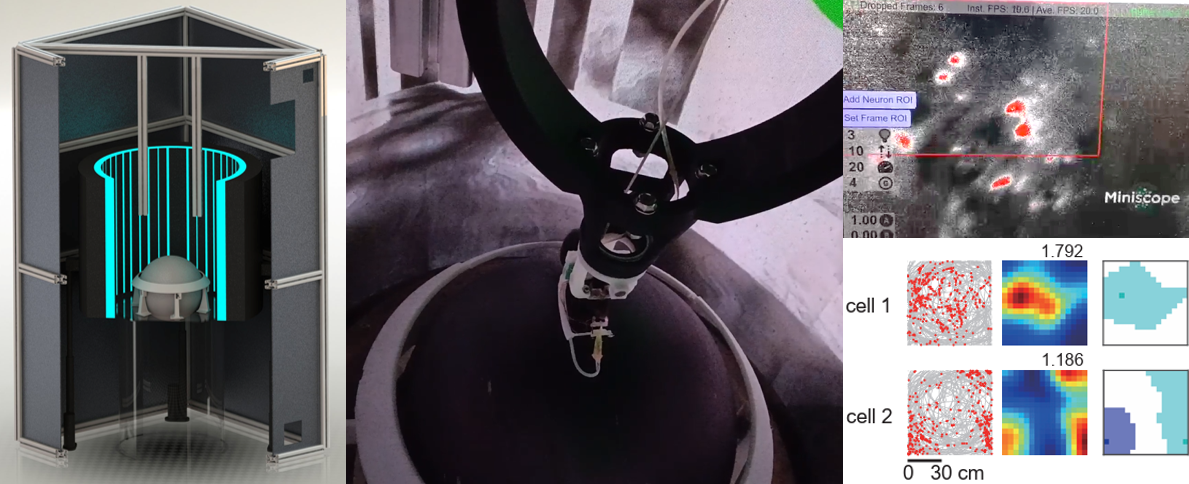
This panoramic virtual reality (VR) system integrates 360° visual stimulation with a spherical treadmill while preserving the mouse's freedom of horizontal head rotation. It supports a variety of behavioral paradigms, including one-dimensional corridors, two-dimensional open fields, T-mazes, reward displacement tasks, and abstract visual stimuli. The system is compatible with neural recording techniques such as tetrodes, Neuropixels, and UCLA Miniscope, enabling simultaneous recording of behavior and neural activity.
Layer-Specific AAV Tools
Resource item

Layer-Specific AAV Tools

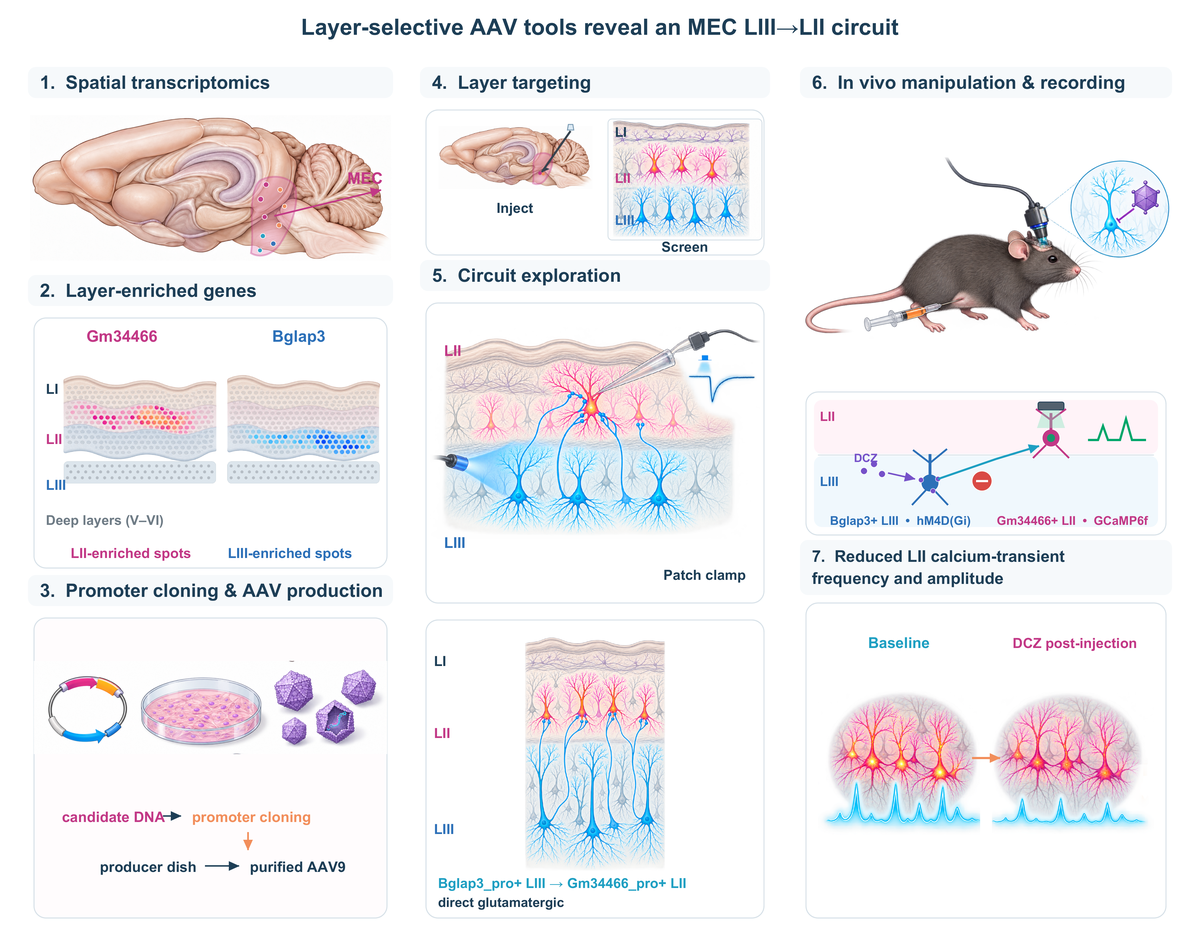
This study employed spatial transcriptomics to identify candidate regulatory sequences with layer-specific expression patterns and developed AAV regulatory elements that selectively label layer III neurons and a calbindin-enriched layer II neuronal subpopulation in the entorhinal cortex. Through molecular and anatomical validation, optogenetics-assisted patch-clamp recordings, chemogenetics, and two-photon calcium imaging in freely moving mice, we identified direct glutamatergic inputs from layer III neurons to the targeted layer II subpopulation. Furthermore, inhibition of layer III neurons reduced both the frequency and amplitude of calcium transients in downstream layer II neurons. Figure: Workflow from the identification of layer-enriched candidate regulatory sequences and AAV9 vector construction and production to validation of layer-specific expression, circuit mapping, and in vivo functional assessment.

Neuroscience in Focus
Resource item

Neuroscience in Focus

Here we share weekly content for Journal Club, alongside popular science videos covering articles published by our research group. You are welcome to follow us and engage in discussions!